Moscow, 18 September 2026
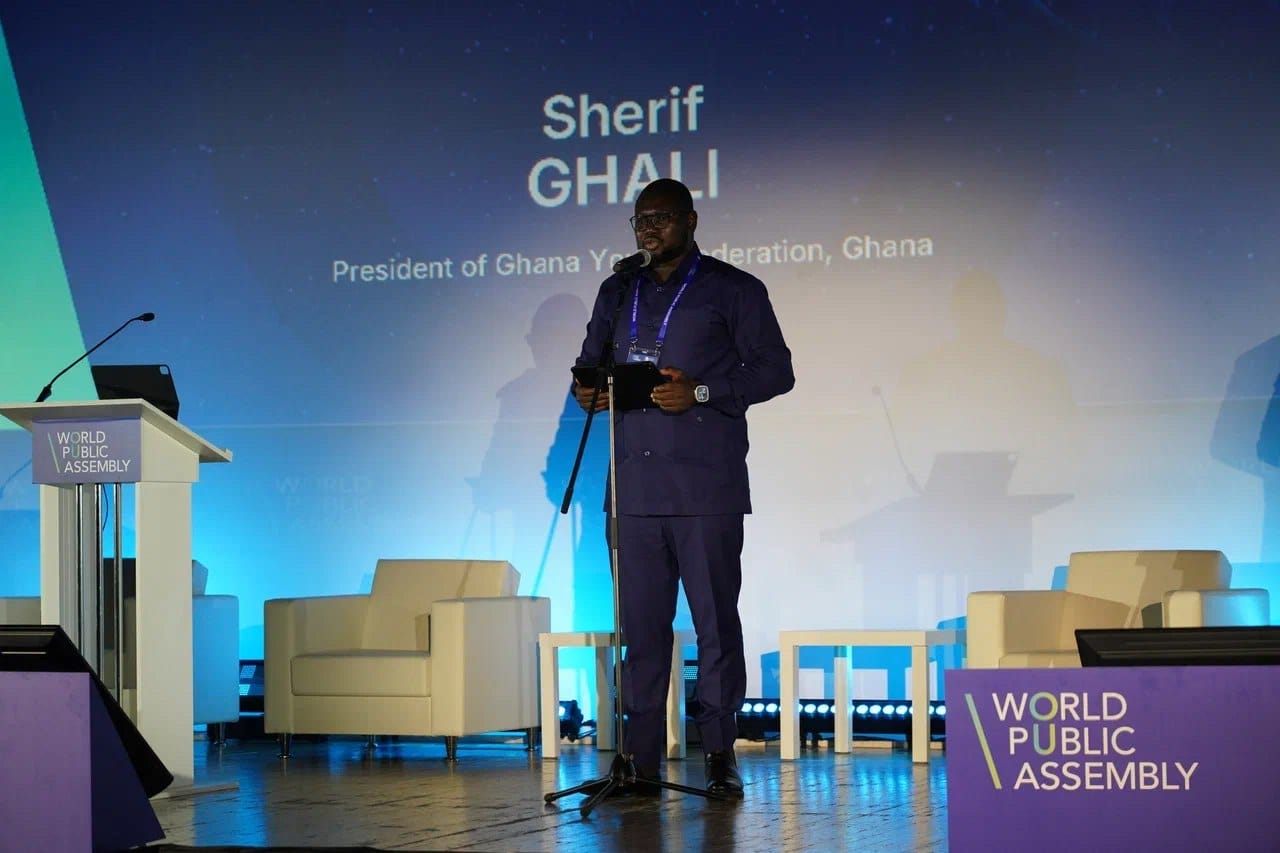
The President of the Ghana Youth Federation, Sherif Ghali, has challenged governments and international institutions to move youth participation out of communiqués and into the instruments that bind, telling delegates at the Second World Public Assembly that a seat at the table means nothing without a vote at the table.
He was speaking at the plenary session Values of the New World: A Youth Perspective, held on the opening day of the Assembly, which convenes under the theme New World: Values That Unite and runs alongside the second International Youth Forum, Generation of Unity. His assigned topic was meaningful youth participation in decision making, from symbolic representation to equal participation.
Mr Ghali opened by describing a gap he said exists in almost every capital represented in the hall.
“Right now, in almost every capital represented in this hall, there is a room where a decision about young people is being taken, and there is no young person inside it. And very often, in the same city, on the same day, there is a youth forum discussing that exact decision.”
He acknowledged the progress made in opening institutions to young people, citing his own seats on the Board of Ghana’s National Youth Authority, where he chairs the Subcommittee on Partnership and Resource Mobilisation, and on the Ministry of Youth Advisory Board.
But he warned that presence is routinely mistaken for power.
“A seat is not the same as a vote. A vote is not the same as a decision. You can be in the room, on the programme, and in the photograph, and still have changed nothing.”
He offered the Assembly a single test for measuring youth participation. Delegates should not count how many young people spoke, he said, but examine what changed in the document, the budget or the timeline after they spoke. Where nothing moved, he argued, the exercise was representation rather than participation.
Mr Ghali also directed a demand at young people themselves, saying equal participation is earned in preparation rather than granted by age. He recounted watching young delegates arrive at board tables with grievances and leave with nothing, while others arrived with costed proposals and left with decisions.
On the scale of the constituency involved, he pointed to Ghana’s own application data. More than 230,000 applications were submitted when two national programmes for young entrepreneurs opened, and a digital skills programme received 94,000 applications within 48 hours.
“That is not a generation waiting to be activated. That is a generation already pushing on a door.”
He set out three actions with named owners. Governments and institutions should write youth participation into law, board composition, terms of reference and budget lines. Youth organisations should arrive with a mandate from an organised constituency and report back to it. And the Assembly itself, he proposed, should require every initiative leaving Moscow to name a young co-lead and report the following year on what that person decided.
Mr Ghali referenced the African Communiqué adopted at the Assembly’s African summit in Addis Ababa in July, which affirmed that the continent’s greatest wealth is its people and recommended a network of young African leaders in public diplomacy.
He closed by framing youth inclusion as a condition of the Assembly’s own theme, telling delegates that cooperation between peoples cannot skip a generation and still call itself cooperation, and that Africa arrives at such platforms looking for partners and markets rather than sympathy.
The Ghana Youth Federation is the national umbrella body for youth organisations in Ghana.